
Scurry Projected and Actual Release
TDCJ defines a projected release date as the date Classification and Records predicts a person will leave incarceration if parole does not occur first. It is a forecast made within the state-prison system. The actual release date records when the agency completed the custody event. A parole eligibility date marks when review may occur. The maximum sentence date marks another boundary. None should be substituted for another.
A pretrial detainee at Scurry County Jail usually has no computed TDCJ date. Bond, dismissal, a plea, sentencing, credit, court action, and other holds can determine what happens next. Even a county sentence needs its own jail-credit calculation. A person at Price Daniel Unit, by contrast, is in statewide TDCJ custody and may have several labeled dates in the offender record.
Find Scurry County Projected Dates
First identify the custody layer. Searching TDCJ for a county-only bond case can produce a false same-name match or nothing useful. Calling Scurry County Jail about a Daniel Unit prisoner sends the question to an office that does not compute the state date.
- Confirm whether the person is held at Scurry County Jail, Price Daniel Unit, another TDCJ unit, or another agency.
- For TDCJ custody, open the TDCJ Offender Information Search.
- Search by TDCJ or SID number when available. Otherwise use full name and reconcile age, race, gender, conviction county, offense, and sentence.
- Copy “Projected Release Date,” “Parole Eligibility Date,” and “Maximum Sentence Date” separately, exactly as labeled.
- If the online result is incomplete, email pia@tdcj.texas.gov with the full name and seven-digit TDCJ number, or exact birth date or approximate age and conviction county when the number is unknown.
- For a county-jail case, call 325-573-3581 and obtain the court order plus the jail-credit and release calculation.
The Scurry County release search explains the written sheriff request when the exact county release time or destination is needed.
Scurry TDCJ Release Date Labels
TDCJ says its information channels can return incarceration status and location, projected release date, parole eligibility date, offense, conviction county, case number, sentence date and length, and prior incarceration history within the published scope. These fields help test identity and explain the date. A missing current unit does not, by itself, prove full discharge.
| Label | Meaning |
|---|---|
| Projected release date | Classification and Records forecast if parole does not occur first |
| Parole eligibility date | A threshold for review, not approval or release |
| Maximum sentence date | The sentence boundary shown by TDCJ, subject to the record’s legal structure |
| Current unit or status | Present state custody information; another unit can mean transfer |
| Release or incarceration history | Past state events when returned or obtained through the records channel |
The official TDCJ definitions explain projected release as illustrated below.
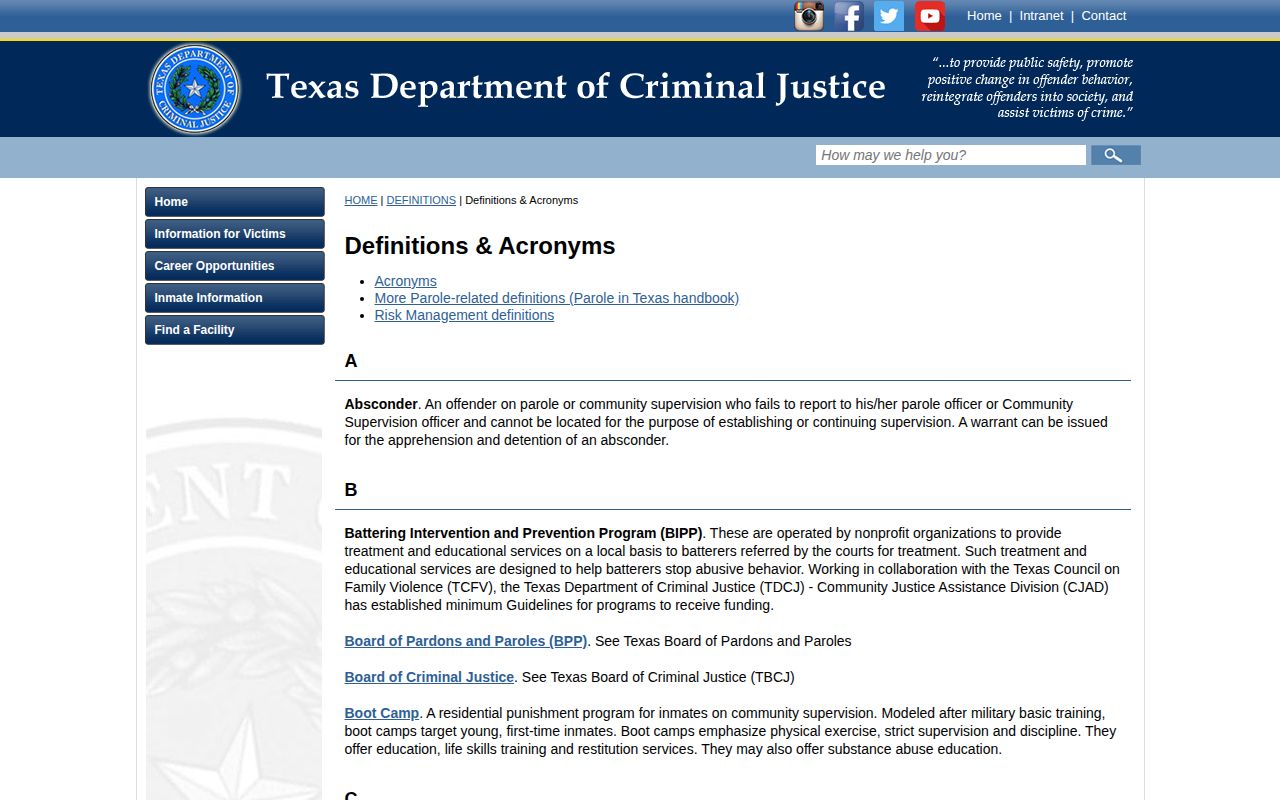
The definition shows why the field must be read as a projection, not a promise of a specific exit.
For someone who has already left TDCJ, seek incarceration history and the release or discharge record if the online detail is thin. A person on parole or mandatory supervision has left prison but remains under TDCJ supervision. A person who moved from Daniel Unit to another unit has not left state custody. The statewide status, rather than absence from the Daniel Unit page, distinguishes those outcomes.
Texas Good Time in Scurry
Texas Government Code §§498.003 through 498.005 govern TDCJ good-conduct time. Section 498.003 permits awards based on classification and conduct and states that credit is a privilege, not a right. Section 498.004 addresses forfeiture and possible restoration. Section 498.005 limits the credit’s effect to parole or mandatory-supervision eligibility under Chapter 508. It does not otherwise shorten the sentence imposed by the court.
Mandatory supervision also depends on offense date and eligibility. Under §508.147, calendar time plus accrued good-conduct time can drive the general mechanism, while §508.149 excludes listed offenses and permits discretionary denial for eligible post-1996 cases. TDCJ notes a distinct rule for eligible offenses committed before September 1, 1996. That date is one reason a rule from one record cannot be copied to another.
There is no universal Texas rule that every state prisoner must serve 85 percent. Section 508.145 contains different formulas. Many eligible cases use calendar time plus good time reaching one-fourth of the sentence or 15 years, whichever is less. Certain designated serious-offense or deadly-weapon cases generally require calendar time equal to one-half of the sentence or 30 years, whichever is less, with at least two calendar years. Eligibility never guarantees release.
Scurry County Jail Date Calculation
A county-jail sentence does not use the TDCJ projected-date field. Texas Code of Criminal Procedure Article 42.032 allows the sheriff in charge of a county jail to grant commutation for good conduct, industry, and obedience under the statute’s conditions. The reviewed Scurry County sources do not publish a local credit rate or implementation schedule.
Ask the sheriff for the calculation applied to the identified sentence. The request can seek booking and commitment dates, jail credit, the controlling judgment, any credited time, the release date and time, and the reason or destination. Do not import another county’s “two-for-one” practice. No fixed Scurry release hour, Sunday release rule, or weekend early-release practice was established.
A court order supplies the legal authority, while the jail movement record proves when staff carried it out. A new warrant or agency hold can block community release even after the local sentence calculation reaches its endpoint.
Pretrial cases follow another path. A bond or personal-bond order may authorize release while the charge continues. Dismissal or acquittal can end the charge, yet the booking record may remain unless later law restricts it. “Time served” addresses the confinement reflected in an order. None of those terms should be turned into a TDCJ projected date. Ask the jail and court what the identified record actually states.
Why Scurry Release Dates Change
A projected date can move because the legal and administrative inputs change. The safest record preserves the date viewed, the exact label, and the agency source. When the value changes, seek the new calculation rather than treating the older screen as an error.
| Factor | Possible effect |
|---|---|
| Classification or earning class | Changes how TDCJ projects eligible credit |
| Forfeiture or restoration | Removes or restores good-conduct credit under state rules |
| Jail credit | Changes credited calendar time when lawfully applied |
| New judgment or stacked sentence | Changes the controlling sentence structure |
| Detainer or hold | Can prevent entry into the community after one custody term ends |
| BPP action | Approval, denial, withdrawal, or later review can alter the expected path |
| Legal recalculation | Corrects the date after records or rules are applied |
Confirm Scurry County Release Dates
For a county detainee, call Scurry County Jail and request the written release record. Texas VINE can provide notice of a reported county custody event, but the event should be checked against the jail and court. For Price Daniel Unit, use TDCJ Offender Information, then Classification and Records or the proper TDCJ records channel if a formal history is needed.
A pending-event alert is useful when the date may change. The Scurry County VINE inmate check explains county registration and the separate VNS/IVSS route for TDCJ custody. After an alert, confirm whether the event was release, transfer, bench-warrant movement, or discharge. A transfer away from Daniel Unit is still state custody, and a favorable parole vote can remain subject to processing, a program condition, or a detainer.
Preserve a dated copy of the result and the identifier used. If a later projected date differs, compare the newest TDCJ label and ask the records office about the current computation. The older value may have been accurate when viewed. For county cases, compare the sheriff’s custody history with the controlling court order. That pair shows both the legal authority and the act of release more clearly than an unlabeled date copied from a search result.
When making a TDCJ inquiry, include the full name and seven-digit TDCJ number. If that number is unknown, provide the exact birth date or approximate age and the conviction county. TDCJ says the email channel may return the current status, location, projected date, parole eligibility date, offense, sentence facts, and prior incarceration history within its scope. Requesting each field by name helps keep the answer precise.
Never infer an exact departure hour from the projected date alone. Release processing, identity checks, paperwork, transport, and unresolved holds can separate the forecast from the event recorded by the agency.
Public Record Search
Sponsored Results