
Scurry County Parole or Probation
Parole and probation can both place a person under rules while living outside a jail or prison, but they arise from different records. Parole is conditional release from a TDCJ prison sentence. Mandatory supervision is another form of release from prison under TDCJ oversight. Probation, called community supervision in Texas records, is ordered by a court and administered locally. A person on Scurry County probation may never have entered state prison. Someone paroled from Price Daniel Unit remains in the TDCJ system even when the person lives in Snyder.
| Record type | Who creates it | Best confirmation |
|---|---|---|
| Parole | Texas Board of Pardons and Paroles decision; TDCJ release and supervision records | TDCJ offender status, BPP channel, then the assigned district parole office |
| Mandatory supervision | TDCJ and BPP under offense-date and eligibility rules | TDCJ status and Parole Division records |
| Probation | The sentencing court’s community-supervision order | Court file, then Scurry County CSCD |
| Full discharge | The agency that held or supervised the person | A final discharge or sentence-completion record |
Verify Scurry County Supervision
Start with the record that explains why the person is outside custody. A county bond record proves release from the jail, but it does not establish parole. A favorable BPP vote proves a decision stage, yet it does not prove that TDCJ completed the physical release. The exact words matter. “Approved,” “release processing,” “released to supervision,” “under supervision,” and “discharged” describe separate points in the process.
- Identify whether the last known custody was Scurry County Jail or a TDCJ unit such as Price Daniel Unit.
- For state custody, search the TDCJ Offender Information Search with a TDCJ or SID number when possible. Copy the current status and date labels exactly.
- Before a Board vote, call the published review-status line at 844-512-0461. After a favorable vote, use the release-status line at 512-406-5202.
- For probation, obtain the judgment or community-supervision order from the court. Then ask Scurry County CSCD for administrative information it may lawfully provide.
- Confirm the assigned office. A Scurry residence does not turn TDCJ parole into county probation.
- If final discharge is the issue, request the discharge record from TDCJ or the court and CSCD rather than inferring it from a search result.
The TDCJ general locator lines, 936-295-6371 and 800-535-0283, are published for identity and location questions. Their stated hours are weekdays from 8 a.m. to 5 p.m. Have the TDCJ or SID number, or an exact birth date, ready. The Scurry County released-inmate search and record guide explains how to obtain the underlying county release sheet when the person left the local jail.
Scurry County Supervision Offices
Scurry County has a local probation office, but its state parole cases route to Abilene. This is more than an address choice. Each office answers for a different legal authority. Begin with the court order or TDCJ record, then contact the matching office. Staff may limit what they disclose, and a public inquiry should not seek a supervising officer’s personal details.
Scurry County CSCD
Probation / community supervision
2511 College Avenue
Snyder, TX 79549-2528
325-573-8524
Fax: 325-573-7814
Abilene District Parole Office
TDCJ parole and mandatory supervision
5241 West Stamford Street
Abilene, TX 79603
325-672-1495
Fax: 325-734-5188
The TDCJ county cross-reference assigns Scurry County to the Abilene office. The image below records that official routing.
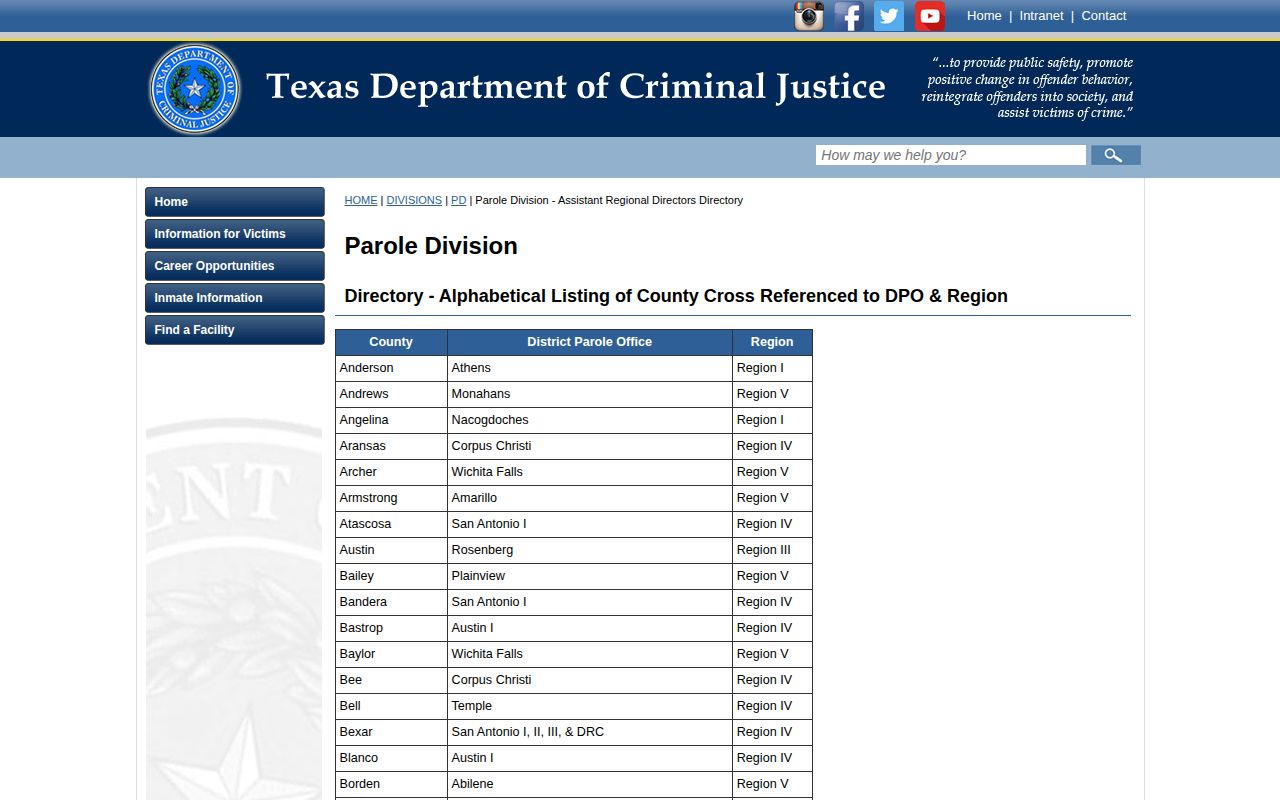
That assignment is the clearest way to avoid sending a Daniel Unit parole question to the local probation office.
Scurry Supervision Status and Warrants
Conditions are rules attached to release or community supervision. A reported violation can lead to a warrant, hearing, changed terms, or revocation, but an allegation alone does not prove the outcome. No general Scurry County warrant or parole-absconder list was found on the official sheriff site. The TDCJ Sex Offender Absconder search is much narrower. It covers only people who meet that system’s public criteria and must not be treated as a list of all alleged parole or probation violations.
Use the court and issuing agency for a suspected warrant. If a TDCJ parole warrant is involved, the Parole Division record is the right layer. A VINE or TDCJ notification may report a custody change, but it does not replace the later revocation order. Likewise, no match in the specialist absconder search says nothing about ordinary supervision. Record the system checked, the identifier used, the exact result, and the date of the check.
Reentry After a Scurry Release
Price Daniel Unit’s official program list includes CHANGES/Pre-Release and Reentry Planning. Those programs show that release preparation exists inside the local TDCJ prison, while eligibility and access remain TDCJ decisions. They do not set a release date or prove that a person completed a program. Confirm the current program and release stage with the unit or TDCJ record.
Snyder-area community listings add a separate, non-custodial layer. They identify resources such as the Snyder Community Resource Center, Scurry County Welfare Office, and West Texas Centers for help navigating documents, health needs, and immediate services. Availability can change. The Snyder community resource directory should be checked directly before relying on a listed service. These community contacts do not verify parole, probation, or discharge.
Scurry Parole Votes and Release
Texas does not hold a public courtroom-style hearing for each parole case. An institutional parole officer prepares a summary, and a three-member panel reviews and votes the file in sequence. Two votes decide. Administrative Board meetings and published minutes are not an individual person’s parole calendar. Review may begin months before eligibility, but eligibility is only the threshold for review.
A grant can include a future date or program requirement. Common decision codes reflect different paths, and approval may be withdrawn if new facts arrive. A detainer can also stop the person from entering the community after one custody layer ends. Before a decision, use the review-status channel. After a favorable vote, use the post-vote release line. Then confirm the actual departure through TDCJ. This order prevents a vote date from being reported as a release date.
The operational review cycle is not a public hearing date. TDCJ materials say Parole Division identifies cases about six months before initial eligibility and about four months before a later review. An institutional parole officer interviews the prisoner and prepares a summary. The file then goes to the designated Board office. A denial notice includes later review timing, but that timing is still not a promised release.
Decision terms also need context. FI-1 and future-date or program variants from FI-2 through FI-18R are grants with different processing paths. RMS concerns mandatory supervision. NR sets another review, SA means serve all, and DMS denies mandatory supervision. Copy the current code and explanation from the official record. Do not convert a code into a physical release claim.
Scurry County Supervision Discharge
Supervision ends through a formal record, not mere silence in a locator. For TDCJ parole or mandatory supervision, seek the final TDCJ discharge or sentence-completion record. For probation, use the sentencing court’s order and the CSCD file. A transfer between offices does not end supervision. Nor does the end of physical custody at Scurry County Jail settle a separate state sentence, warrant, or court term.
Texas public-record access is subject to exceptions for confidential, juvenile, victim, security, and protected personal material. Ask for the public status, dates, and order that answer the narrow question. Redactions do not make the remaining record invalid. The cleanest conclusion states the exact layer proven: county jail release, active probation, release to parole, mandatory supervision, or full discharge.
If the public search is incomplete, request the incarceration and supervision history from the record holder. Include the full name, TDCJ or SID number when known, exact birth date, and conviction county. For a local probation matter, add the cause number and sentencing court. These identifiers reduce same-name mistakes and help the office locate the correct order without asking for a broad file.
Public Record Search
Sponsored Results